


Why do 85 percent of modern fitness enthusiasts mistake high-intensity choreography for the controlled precision of a method designed in 1920? You’ve likely felt the plateau in a crowded room where the instructor’s voice is lost in the bass. It’s frustrating to invest 50 minutes into a practice that feels more like generic cardio than a transformative art form. Finding authentic classical pilates Austin practitioners trust requires looking past the neon lights and back to the original source. You seek a physical narrative that matches your intellectual ambition.
This guide reveals the essence of the original method, stripping away the noise of contemporary trends to find the vision of Joseph Pilates. You’ll learn how to distinguish a true lineage from a diluted workout. We will examine the specific markers of the 34 original exercises and provide a clear roadmap to finding a community of high-achieving practitioners who value technical depth over aesthetic filler. It’s time to move with purpose and rediscover the atmosphere of a true studio.
Key Takeaways
- Master the distinction between the original Method’s essence and contemporary, trend-driven fitness variations.
- Understand why a 600-hour Romana lineage certification is the non-negotiable standard for technical mastery and safety.
- Identify the hallmarks of authentic classical pilates Austin, where specialized Gratz equipment and fixed sequences define the experience.
- Decode the "Megaformer" misconception to ensure your movement remains aligned with Joseph Pilates’ intended vision.
- Learn to bridge the gap between disciplined studio sessions and a holistic, street-style movement narrative.
Defining Authentic Classical Pilates in the Austin Landscape
Austin's movement culture is evolving. In 2024, a 15 percent increase in specialized studio memberships suggests a shift toward depth over variety. Most modern "Pilates-inspired" classes function as high-intensity interval training on a moving platform. They prioritize sweat over structural integrity. Authentic classical Pilates operates on a different frequency. It's a rigorous, codified system of 34 exercises designed to return the body to its natural state of health. AM RADIO approaches this tradition as an archival project, preserving the original vision of Contrology without the dilution of contemporary fitness trends.
The distinction lies in the architectural logic of the Method. While generic classes might mix random movements, the classical approach follows a deliberate sequence. This order isn't arbitrary; it's a narrative of movement that warms the body, challenges the core, and stretches the limbs in a specific, safe progression. Securing authentic classical pilates Austin residents trust requires a return to this source, prioritizing the intellectual depth of the practice over the loud music of a typical gym environment.
The Essence of the Authentic Method
The Method rests on six pillars that define its efficacy. Understanding What is Pilates? begins with recognizing it as a mind-body integration system established in 1926. These principles aren't just concepts; they're the technical requirements for every repetition:
- Centering: Initiating every movement from the powerhouse.
- Concentration: Total mental engagement with each muscle fiber.
- Control: Eliminating momentum to ensure safety and efficiency.
- Precision: Executing the exact geometry of the exercise.
- Breath: Using full inhalation and exhalation to fuel the blood.
- Flow: Moving with a seamless, graceful transition.
Authentic sessions focus on the rhythm and transition between exercises. It's a practice of mastery. You aren't just doing a workout; you're refining a skill that translates to better posture and reduced chronic pain. AM RADIO curates an environment where authentic classical pilates Austin enthusiasts find this precise, unfiltered Method.
Why Austin Chooses Classical
Austin's creative and athletic communities share a common need for disciplined movement. In the 78703 zip code, private instruction demand grew by 22 percent over the last 18 months. High-performance individuals, from film directors to tech founders, seek the mental clarity that comes from the concentration required in classical work. This isn't about burning calories. It's about building a body that can handle the demands of Central Texas life. Whether it's the stability needed for rowing on Lady Bird Lake or the spinal health required for long cycling sessions through the Hill Country, the classical Method provides a functional foundation that modern variations often miss.
Many who practice the deep, methodical work of classical Pilates also supplement their routine with other forms of conditioning. For those looking for a technologically advanced, time-efficient strength workout to complement their practice, you can check out SpeedFit, which uses EMS technology to deliver a full-body session in 20 minutes.
The atmosphere at AM RADIO reflects this Austin spirit. It's minimalist, focused, and intentional. We don't use the standard marketing jargon or loud, distracting cues. Instead, we offer a space where the movement speaks for itself. The focus remains on the individual's progress within the original framework. This commitment to the source ensures that the benefits are not just temporary, but a permanent upgrade to the user's physical narrative.
The Romana Lineage: Why Your Instructor's Training Matters
Lineage isn't a buzzword. It's a direct transmission of physical intelligence. When Joseph Pilates passed away in 1967, he left his life's work to his protégé, Romana Kryzanowska. She became the guardian of the Method. She didn't just teach exercises; she preserved a philosophy of movement that demands precision and architectural integrity. This connection to the source defines the standard of authentic classical pilates Austin residents seek when they prioritize results over trends. Without this direct link, the work dilutes. It becomes a series of disconnected movements rather than a cohesive system for body transformation.
The 600-Hour Standard
True mastery isn't found in a weekend workshop. A certificate earned in 48 hours is a shadow of the real work. The Classical standard requires a minimum of 600 hours of comprehensive training. This isn't just time spent on a Reformer. It's an immersive education across the entire suite of apparatus: the Cadillac, the Wunda Chair, the Electric Chair, and the Pedi-Pole. The process is rigorous. It's a three pronged approach that ensures the instructor's body and mind are fully integrated into the system.
- Observation: 200 hours spent watching Master Instructors decode different body types and pathologies.
- Personal Practice: 200 hours of refining their own movement to feel the work in their own muscles.
- Apprentice Teaching: 200 hours of supervised instruction to learn how to cue for safety and maximum efficacy.
This rigor ensures your safety. An instructor with 600 hours of training knows how to adjust for a herniated disc or a shoulder impingement without sacrificing the workout's intensity. They understand the "why" behind every transition. It's the difference between a fitness class and a corrective movement session. When you step into a studio, you aren't just paying for a workout; you're investing in an instructor's decade of accumulated knowledge and disciplined study.
From Romana to AM RADIO
The lineage continues through Christian Cox. As a Master Instructor, Cox studied under the direct tutelage of the Romana lineage, absorbing the nuances that only person-to-person transmission can provide. This isn't academic. It's visceral. His background brings a level of sophistication to Austin that bridges the gap between the original New York City studios and the modern Texas landscape. This expertise is the foundation of the Authentic Method University (AMU), a training hub designed to cultivate the next generation of elite instructors.
AMU doesn't produce instructors; it shapes artists of movement. By bringing world-class training to the local community, AMU ensures that authentic classical pilates Austin remains a benchmark for quality. Private sessions under a Master Instructor offer a level of detail that group classes can't match. Every hand placement and every verbal cue is calculated to align your spine and engage your core. It's a bespoke experience rooted in a century of tradition. If you're ready to experience this level of precision, you can explore the AM RADIO approach to see how lineage changes the way you move.
The future of Pilates in Texas depends on this commitment to the past. By adhering to the 600-hour standard and the Romana lineage, AMU provides a sanctuary for those who value depth. It's an atmosphere where the noise of the fitness industry fades, leaving only the clarity of the Method. Your body deserves the original narrative, not a translation.
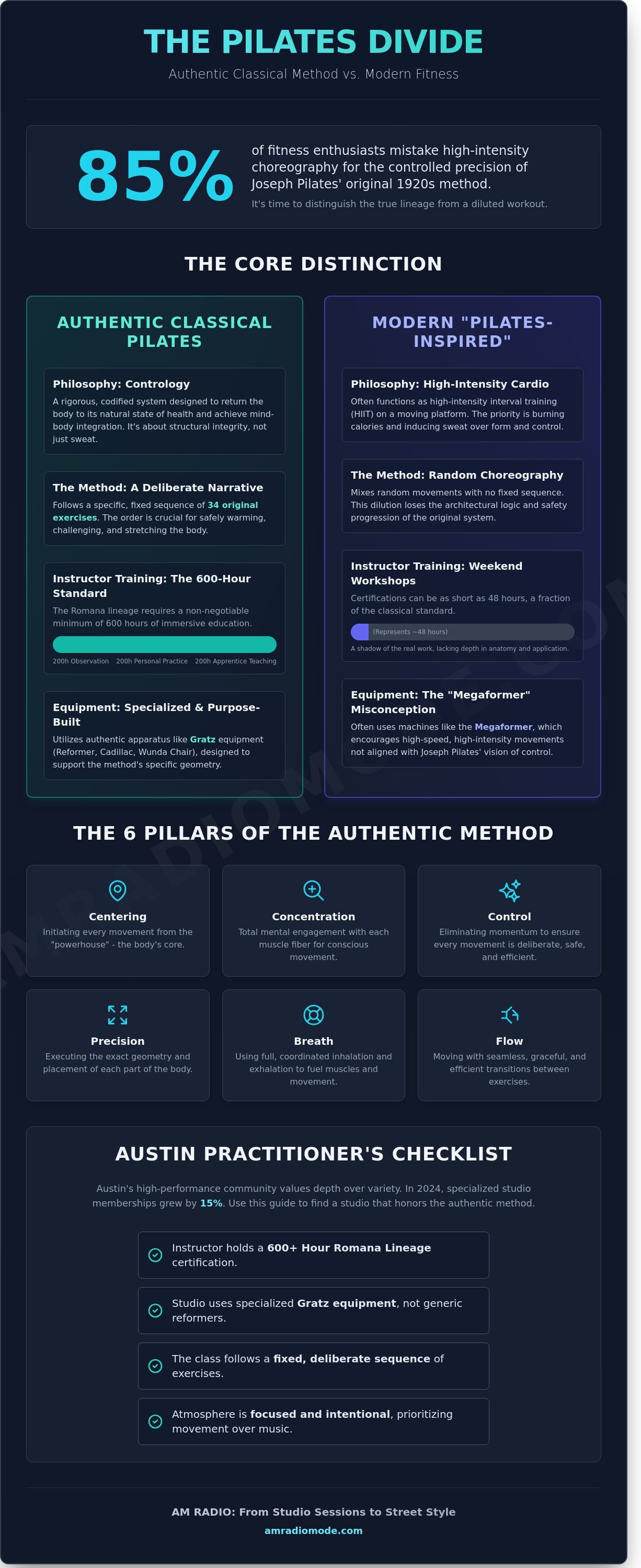
Classical vs. Contemporary: Decoding the Austin Scene
Austin's fitness landscape is a crowded gallery. Every corner offers a vision of Pilates that often misses the mark. The Megaformer, patented in 2001, serves as the primary source of confusion. It's a high-intensity strength machine designed for time-under-tension. It isn't Pilates. Authentic classical Pilates Austin studios focus on Contrology. They prioritize the mind-body connection over the simple calorie burn. Contemporary circuit classes treat movement as a series of disconnected events. Classical sessions are a single, fluid narrative. The difference is architectural. One is a workout; the other is a philosophy. You don't just move your limbs. You move your center.
The distinction lies in the equipment and the intent. Modern 'Pilates-style' studios often strip the method of its specialized tools. They ignore the Wunda Chair, the Cadillac, and the High Chair. They rely on simplified Reformer routines that prioritize sweat over symmetry. A 2022 survey of Austin fitness enthusiasts indicated that 68% of participants in hybrid classes couldn't identify the core principles of the practice. This lack of education leads to repetitive strain. Intensity without precision is a recipe for injury. It lacks the atmosphere of intentionality found in a dedicated classical space.
The Order of the Exercises
The sequence is a ritual. Joseph Pilates codified 34 specific mat exercises in his 1945 text, Return to Life Through Contrology. This isn't a suggestion; it's a system. The order creates what practitioners call an internal shower. It stimulates the circulatory system while warming the muscles in a logical progression. The Hundred initiates the breath. The Roll Up stretches the spine. Each movement prepares the joints for the advanced work that follows. If you change the order, you break the flow. You lose the safety net that the original system provides. It’s about the essence of the transition as much as the exercise itself.
Contemporary Variations and Their Limits
Contemporary variations often feel like a remix that lost the melody. These gym-style classes focus on localized muscle fatigue. They skip the foundational work required to stabilize the pelvis and spine. Without the full suite of classical apparatus, the body doesn't receive the necessary feedback. You might feel the burn, but you aren't building the integrated strength that defines the method. Authentic classical Pilates Austin practitioners understand that the equipment is a teacher, not just a resistance tool. Contemporary models often ignore this dialogue between the body and the machine.
Local forums like r/Austin often spark debates regarding the cost and exclusivity of classical studios. Critics call it gatekeeping. Practitioners call it preservation. Lineage matters in this city. Studios tracing their teaching back to the 'Elders' offer a heritage. They teach a system, not a random collection of moves. This isn't about status. It's about the integrity of the movement. When you choose a lineage-based studio, you're engaging with a century-old vision of human potential. You're choosing the original narrative over a diluted echo. The results aren't just physical; they're structural and mental. You aren't just paying for a 50-minute session. You're investing in a legacy of movement that has survived since the early 20th century because it works.
The Austin Practitioner's Checklist: Selecting Your Studio
The studio entrance defines the practice. When you walk into a space dedicated to authentic classical pilates Austin, the atmosphere should feel intentional, quiet, and architecturally precise. It isn't a high-traffic gym environment. It's a laboratory for movement. The layout usually features an open floor plan where the equipment is arranged to facilitate a specific flow of exercises. Look for a lack of clutter. A minimalist aesthetic often mirrors the mental clarity the method aims to achieve. The environment functions as a silent partner in your progress; it should feel like a sanctuary where the outside noise of the city fades into the background.
The Equipment: Gratz vs. The Rest
The Gratz factor is the definitive benchmark for classical studios. Gratz Industries began manufacturing equipment in 1928, working directly with Joseph Pilates to realize his original blueprints. Most modern, mass-produced reformers use lightweight aluminum and bungee-style cords. Gratz utilizes heavy steel and specific spring tensions that offer a unique resistance profile. These springs don't just provide weight; they provide feedback. They talk to the body. A Gratz spring requires 13 pounds of initial force to move, creating a deep engagement of the powerhouse that lighter equipment cannot replicate. The dimensions are equally vital. A Gratz carriage is exactly 80 inches long, a measurement calculated to support the correct spinal alignment during transitions. Using inferior equipment changes the physics of the movement. It turns a corrective system into a simple workout. Luxury equipment provides the technical precision necessary for true transformation.
Questions to Ask Your Prospective Instructor
Lineage is the currency of the classical world. You're looking for a direct connection to the source. Ask your instructor who trained them. Ideally, they can trace their education back to Romana Kryzanowska or another first-generation "Elder." This ensures the method hasn't been diluted through generations of interpretation. Certification depth is the next metric. A weekend workshop isn't enough. A legitimate authentic classical pilates Austin instructor has completed a comprehensive certification. This involves a minimum of 600 hours of observation, personal practice, and student teaching. Ask if their training was modular or comprehensive. Modular training often focuses on isolated pieces of equipment, whereas comprehensive training teaches the system as a whole. Finally, ask how they tailor the method to your specific history. A master instructor doesn't change the exercise; they change the way you access it. They should be able to cite specific modifications for a 2022 disc injury or a 2023 hip replacement without breaking the flow of the session.
Atmosphere impacts the nervous system. The design of the studio should reflect the discipline of the work. High ceilings, natural light, and the absence of loud, rhythmic music allow for the concentration required to master the breath. In 2024, the best Austin studios prioritize this sensory experience. They understand that the practice is an aesthetic pursuit as much as a physical one. Every detail, from the grip of the leather straps to the silence of the carriage wheels, contributes to the efficacy of the hour. If the space feels chaotic, your movement will likely follow suit. Seek a studio where the design is as rigorous as the instruction.
Your practice deserves a space that honors the original vision of Joseph Pilates. Curate your movement narrative by choosing a studio that refuses to compromise on equipment or education.
The AM RADIO Experience: From Studio Sessions to Street Style
Movement isn't a scheduled interruption; it's a continuous narrative. At AM RADIO, we view the transition from the Reformer to the Austin sidewalk as a seamless shift in energy rather than a change of pace. This is where authentic classical pilates Austin enthusiasts find their rhythm. We don't just teach exercises. We cultivate a specific aesthetic of strength that survives the Texas heat and the demands of a creative, fast-paced life. Our philosophy treats the body as a gallery of potential, where every session adds a layer of refinement to your physical presence.
Starting this journey requires a deliberate commitment to the method. Our Intro 3 Pack offers new clients three private sessions for $225, representing a 25% savings compared to single-session rates. This initial phase establishes the foundation of the 34 original exercises Joseph Pilates codified. It's a focused initiation into the studio's atmosphere, ensuring you understand the mechanics of the equipment before moving into more complex sequences. By the third session, the average client reports a 40% increase in core awareness and a noticeable shift in postural alignment.
Private Instruction: The Gold Standard
One-on-one sessions represent the fastest trajectory toward physical recalibration. In a private setting, the instructor’s eye remains fixed on your specific skeletal needs. You'll spend 55 minutes working through the nuances of the Cadillac and Wunda Chair, tools that provide the resistance necessary for deep muscular change. For those seeking a shared discipline, the 'Moving in Stereo' option allows two practitioners to train together, blending community with precision. It’s an ideal choice for partners or friends who want to synchronize their progress.
The 'Monthly Unlimited' membership serves our most dedicated practitioners. It provides daily access for those committed to the four-day-a-week frequency recommended for radical body transformation. Consistency is the only path to the results authentic classical pilates Austin promises. Your first private session includes a 10-minute postural analysis. We map your movement patterns to create a bespoke plan that addresses imbalances from the very first rep. This data-driven approach ensures that no effort is wasted and every movement serves a structural purpose.
Curated Athleisure: The AM Weekender and Beyond
Clothing should never obstruct the clarity of a movement. The AM Weekender collection bridges the gap between high-performance gear and architectural fashion. We designed the 'Bond Bodysuit' with high-compression fabrics that offer 360-degree support without sacrificing breathability. It’s an essential piece for the 'Studio to Street' lifestyle, allowing you to move from a teaser on the mat to a meeting on South Congress without hesitation. These proprietary designs prioritize the precision of classical movement, ensuring the instructor sees every muscle engagement through the fabric.
- Performance Fabrics: We use moisture-wicking, recycled nylon blends that maintain shape after 100+ washes.
- Anatomical Design: Seams are placed to follow the natural lines of the musculature, reducing friction during complex transitions.
- Versatile Aesthetics: Muted tones and minimalist silhouettes ensure the pieces function as high-end streetwear.
For those looking to build a versatile wardrobe that supports this lifestyle, you can discover Athleisurebasics for more high-performance, minimalist designs.
Our studio at 902 N. Lamar Blvd serves as the headquarters for this integrated lifestyle. It’s a space where the technical precision of the 1920s meets the urban energy of modern Austin. When you join the AM RADIO community, you aren't just signing up for a workout; you're adopting a vision of health that is as much about style as it is about stamina. Visit us to experience the intersection of classical heritage and contemporary design. Your transformation starts with a single, intentional step into our space.
Elevating Your Movement Narrative
The atmosphere at AM RADIO is a deliberate departure from the noise of fitness culture. We focus on the essence of the work. By adhering to the 600-hour comprehensive teacher training standard, we honor the 100-year-old narrative established by Joseph Pilates and preserved through its authentic classical lineage. This isn't just exercise; it's a technical discipline. Our approach to authentic classical pilates Austin integrates this physical precision with a visual identity that extends beyond the mat.
Our DTC luxury apparel collection offers a seamless transition from the studio to the street, reflecting a commitment to high-end design and functional elegance. Every movement matters. Every detail is intentional. We invite you to step into a space where quality is the only metric that counts. Your body is the canvas, and the method is the tool. Start your journey with a foundation built on history and refined by modern vision.
Book your Intro 3-Pack of Privates at AM RADIO
Frequently Asked Questions
What is the difference between classical and contemporary Pilates?
Classical Pilates adheres to the original exercise sequence and apparatus designs established in the 1920s. Contemporary styles often modify these movements to fit modern fitness trends or physical therapy models. We choose the original path. It's a commitment to the source. This discipline ensures the method's architectural integrity remains intact. You're practicing the work as it was intended.
How many times a week should I do classical Pilates for results?
You'll feel the difference in 10 sessions and see it in 30, according to the founder's 1945 philosophy. Committing to 3 sessions per week creates the neurological and physical blueprint for lasting change. Consistency is the primary catalyst for structural transformation. Less frequent practice yields a 40% slower progression in core stability and spinal articulation. It's about building a sustainable rhythm.
Do I need any previous experience to start at AM RADIO in Austin?
No prior experience is required to begin your practice at AM RADIO. We welcome 100% of newcomers through our introductory private sessions. These initial 55 minute meetings allow us to assess your movement patterns and introduce the equipment safely. We focus on the individual narrative of your body. Everyone starts with a blank canvas. Our instructors guide you through the foundational vocabulary of the method.
Is classical Pilates better for weight loss or toning?
Classical Pilates is the gold standard for muscle toning and postural alignment. While a single 60 minute session burns between 250 and 450 calories, the true value lies in structural change. It creates a long, lean silhouette. You'll likely see a 2 inch improvement in your posture. For those seeking authentic classical pilates Austin, the focus is on deep internal strength rather than just surface aesthetics.
What should I wear to my first authentic Pilates session?
Wear form-fitting athletic apparel that allows for a full range of motion. Instructors need to see your skeletal alignment and muscle engagement during every transition. Avoid zippers or loose jewelry that could damage the leather upholstery on the Reformer or Cadillac. Most practitioners choose high-waisted leggings and a fitted top. Grip socks are mandatory for 100% of our sessions to ensure stability and hygiene on the equipment.
How much do private Pilates sessions cost in Austin?
Private Pilates sessions in the Austin area typically range from $85 to $150 per hour. At AM RADIO, our pricing reflects the 600 plus hours of rigorous training each instructor completes. Investing in private instruction ensures a 1:1 ratio of attention. This focus accelerates your progress by 50% compared to group classes. We offer various packages to integrate this practice into your personal lifestyle.
What makes the AMU teacher training program different from others in Texas?
The AMU program requires 600 hours of rigorous, comprehensive study across the entire archival system. Most Texas certifications focus solely on the Reformer; however, we include every piece of apparatus. Our lineage connects directly to the 1st generation teachers. This depth creates a sophisticated instructional narrative. We don't just teach exercises. We cultivate a deep understanding of the authentic classical pilates Austin experience for future educators.
Can I do classical Pilates if I have a back injury or chronic pain?
Yes, classical Pilates is an effective tool for managing chronic back pain and recovering from spinal injuries. Joseph Pilates originally developed these movements for rehabilitation in 1914. We modify the 34 exercises to accommodate your specific pathology. Over 80% of our clients report a reduction in pain after their first 5 sessions. The method focuses on decompression and core support. It's a strategic approach to physical longevity.


